


For generations, the narrative that Africa “has no history” has circulated through academic halls, colonial writings, and public discourse. Yet this claim collapses immediately when confronted with a simple fact: the majority of Africa’s most important cultural, royal, and spiritual artifacts lie not on the continent, but in European museums.
Locked behind glass in London, Paris, Brussels, Berlin, and elsewhere are tens of thousands of objects taken through conquest, forced treaties, coercion, and colonial violence. They have become silent evidence of Africa’s long, advanced, and sophisticated civilizations—evidence that Europe continues to keep far from African soil.
The Scramble
The large-scale removal of African artifacts accelerated during the late nineteenth century, particularly between 1884 and 1914 during the period historically known as the Scramble for Africa. As European powers carved the continent into colonies, they also seized control of kingdoms, palaces, and sacred spaces. Military expeditions frequently doubled as extraction missions.
After battles, soldiers looted royal courts. Colonial officers shipped home treasures. Missionaries collected religious objects they considered “pagan”. Administrators implemented systematic removal as a means of cultural domination. These items were transported to Europe, where they became proof for emerging ethnographic museums that Africa was a land to be studied, not a continent of equal civilizations.
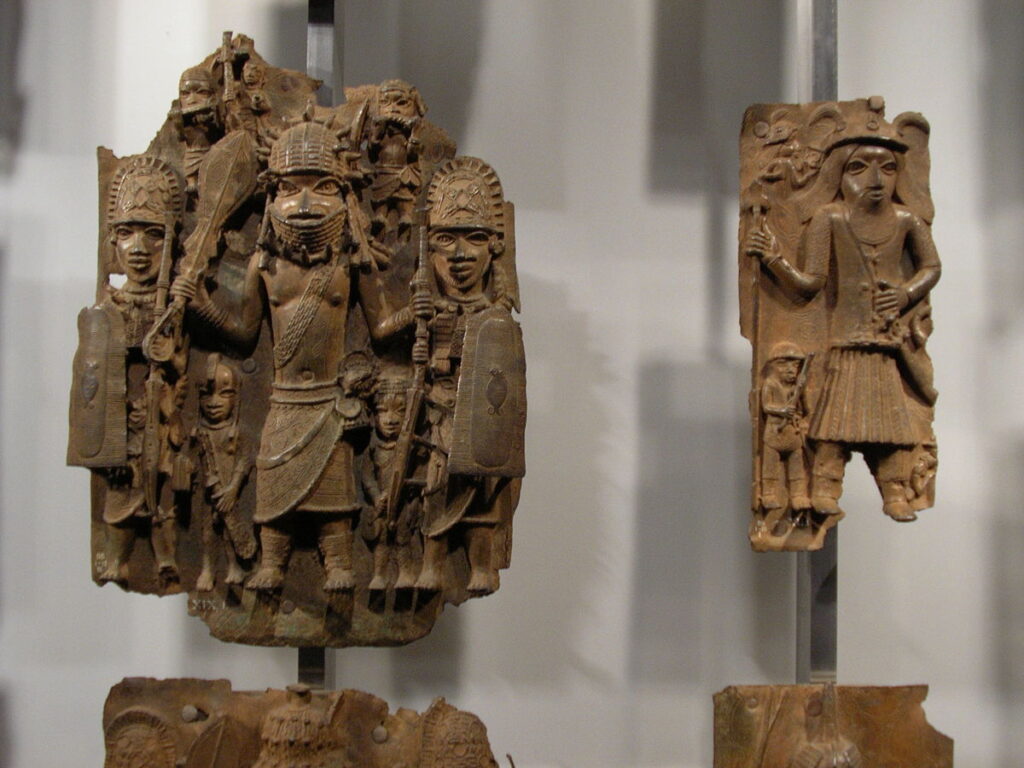
Britain: One of the most documented examples is the looting of the Kingdom of Benin in present-day Nigeria. In 1897, British forces attacked Benin City, burned it to the ground, and seized thousands of brass plaques, ivory carvings, coral regalia, ceremonial heads, and royal furniture. These objects, later known as the Benin Bronzes, had been produced between the fifteenth and nineteenth centuries using advanced metallurgical techniques. The bronzes depicted court life, royal lineages, diplomatic relations, and religious practice.
After the invasion, British officers divided the spoils, selling them to museums across Europe and North America. Today, the British Museum alone holds more than nine hundred items from Benin, while others are distributed in museums in Germany, Austria, the United States, and the Netherlands. Very few remain in Nigeria.
Beyond Benin, the British Museum holds tens of thousands of items from across sub-Saharan Africa. Some were taken through direct conquest; others were removed during punitive expeditions in Ghana, Sudan, and Kenya. These artifacts include royal regalia, weapons, textiles, religious shrines, and architectural fragments. They reveal a world of complex governance systems, artistic mastery, and technological expertise—contradicting every colonial assertion that Africa lacked history or sophistication.
Belgium: Similarly, Belgium’s Royal Museum for Central Africa amassed around 180,000 objects from the Congo. Much of this collection was built up during the reign of King Leopold II, whose private colony, the Congo Free State, became the site of one of the most brutal regimes in colonial history. Millions of Congolese died through forced labour, famine, and violence.
Amid this, Congolese cultural and spiritual artifacts were removed in vast quantities. Masks, sculptures, ceremonial tools, textiles, and regalia were shipped to Belgium as trophies and displays of “discovery.” These collections became central to Belgium’s national museums, reinforcing the colonial image of African people as subjects rather than creators of civilization.
Germany: Germany’s collections followed similar patterns. During its colonial presence in Namibia, Tanzania, Cameroon, and Togo, Germany extracted an estimated seventy-five thousand African artifacts. Some were acquired after violent campaigns, such as the genocide of the Herero and Nama peoples in Namibia between 1904 and 1908. Sacred objects, ancestral remains, and royal treasures were taken and later catalogued in German ethnographic museums.
France: Through its extensive colonial empire in West and Central Africa, France built one of the largest collections abroad. The Quai Branly Museum in Paris now houses about seventy thousand African objects. Many were taken during military campaigns in present-day Mali, Senegal, Guinea, and Madagascar. Colonial officers considered these objects state property once territories were annexed, and France transported them to institutions that shaped its image as a global cultural centre.
Resistance to Return
Across Europe, these collections remain legally protected. In the United Kingdom, the British Museum Act of 1963 prevents national museums from permanently returning most objects in their possession. The law was designed to preserve national collections, but its effect is to legally secure ownership of items obtained through colonial violence. Similar constraints exist in France, Belgium, and Germany, where national heritage laws define museum collections as state property. Even when governments express willingness to return artifacts, legal structures and political resistance slow the process.
Behind this resistance is also the question of financial and cultural value. African artifacts have become central attractions in European museums, drawing millions of visitors each year. Their presence supports tourism, national prestige, and academic scholarship. Many of the most famous pieces are valued in the millions on the art market, though they are rarely sold due to legal restrictions. European states also fear that large-scale restitution would create a precedent affecting thousands of objects and potentially lead to demands for compensation. These political, financial, and reputational stakes help explain the reluctance to return African heritage to African nations.
Still, African governments, scholars, and cultural leaders have long campaigned for restitution. Nigeria has repeatedly requested the return of the Benin Bronzes since the 1930s. Ethiopia has demanded the restoration of sacred items removed after the British invasion of Maqdala in 1868. The Democratic Republic of Congo has pushed for the return of artifacts held in Belgium. Senegal, Mali, Ghana, and others have joined these calls, developing new museums and cultural institutions to house and protect returned heritage. In recent years, a few returns have occurred, often through universities, private collectors, or individual European states. Yet these are only fractions of what was taken.
The way forward
A sustainable and equitable way forward requires a model that moves beyond the idea of simple ownership. A win-win solution would combine permanent restitution with long-term cultural partnership.
First, objects taken through clear colonial violence should be returned unconditionally to their countries of origin.
Second, European museums and African cultural institutions should establish joint stewardship agreements for collections with shared histories, allowing rotating exhibitions, collaborative conservation, and shared research.
Third, European governments should invest in supporting African museums with training, conservation technology, and infrastructure as part of historical accountability.
Fourth, African states must commit to transparent cultural governance, ensuring that returned objects are preserved, protected, and accessible to the public.
Such cooperation benefits both sides. African nations regain their heritage and strengthen cultural identity for younger generations. European museums maintain scholarly partnerships and access to global networks while acknowledging the historical realities of empire. Instead of holding Africa’s history hostage, Europe would participate in restoring it.
The claim that Africa has no history has always been false. The thousands of artifacts in European museums prove it. The question now is whether those who hold these objects will continue to deny their origins—or finally join in rebuilding what colonialism tore apart.
By Kato Mukasa