








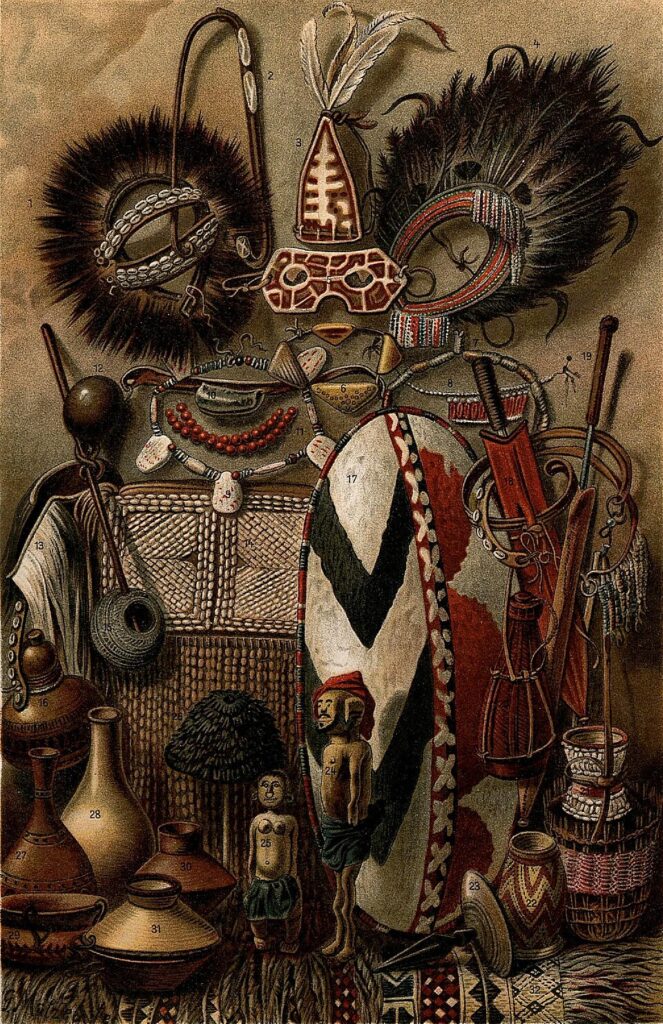
African culture can be seen as a vast, diverse and colourful tapestry of languages, arts, beliefs and traditions stretching across the continent. It features vibrant music and dance, storytelling, colourful clothing, rich culinary heritages together with a blend of indigenous religious practices.
Africans speak over 2,000 languages and there are a multitude of diverse ethnic styles – artistic, functional and spiritual – manifested in masks, sculpture and poetry. These remain integral to cultural life in many African communities.
Underpinning this dazzling cultural mix is the philosophy of Ubuntu – “I am because we are”. This philosophy emphasises respect for elders, and strong family, community and social bonds. Each person is defined through their relationship with others with a particular focus on kinship and the role of ancestors as guides to the living.
Cultural stability
While maintaining deep-rooted, cherished norms, African cultures are not static. They are dynamic, blending traditional heritage with new trends in fashion, music and art. However, some foundations continue largely undisturbed:
- Family and ancestors: A strong emphasis on kinship with ancestors referred to for active guidance
- Music and dance: These are integral to life and arecharacterized by complex rhythms, drumming and singing – crucial during ceremonies and celebrations
- Religion and beliefs: Indigenous beliefs systems, Christianity and Islam often coexist and manifest similar worship of a supreme creator
However, traditional African culture is threatened by the impact of modernity.
The meaning of modernism
The term “Modernism” refers to an artistic and philosophical movement of the late 19th to mid-20th century characterized by a deliberate break from established norms and a search for new ways of expression. Driven by industrialization and the disillusionment which followed the First World War, modernism favoured experimentation, abstraction and functionalism across art, literature, music and architecture.
Key aspects of modernism included:
- Make it new philosophy: Championed by writers like Ezra Pound, modernism rejected the realism of the Victorian era and embraced subjective experience
- Artistic evolution: Modernism brough forth cubism, impressionism and romanticism, notably works by Picasso and Matisse
- Modern literature and architecture: Writers such as James Joyce and architects such as Corbusier and Frank Lloyd Wright grappled with the alienation caused by new technologies and scientific developments. Freudian psychology meanwhile undermined traditional psychological understandings.
Modernism fundamentally altered how humanity understands it’s place in a rapidly changing world.
The impact of modernism
Modernism has had a negative impact on African culture, all things considered.
The impact of modernism has eroded indigenous culture, traditions and values in a process driven in part by the colonial legacy. Traditional knowledge systems are being marginalized or lost, and this has caused profound cultural dislocation and a widespread identity crisis among Africans.
Moreover, traditional family structures are being destroyed as industrialization causes a shift towards urban living. The extended family is consequently being replaced by smaller nuclear units which weaken communal ties and inhibit the transmission of traditional beliefs and knowledge to successive generations.
Change is not always good.
By Godfrey Selbar


