







In 1960, a wave of independence swept the continent. One by one, colonial flags came down. African leaders stood before their people and promised a new dawn of dignity, self-determination, development. The foreign boot had been removed. The future was, at last, African.
What followed is a history written in blood.
Within three years of independence, the Democratic Republic of Congo — the same Congo that had bled under Leopold — watched its first democratically elected Prime Minister, Patrice Lumumba, arrested, tortured, and executed. The CIA was involved. But so were Congolese hands. Joseph Mobutu (Mobutu Sese Seko), who would go on to loot his country of billions while his people starved, was an African. The collaboration between foreign interests and African betrayal did not diminish the African betrayal. It confirmed it.
Nigeria’s civil war, from 1967 to 1970, killed between one and three million people (mostly civilians) — the majority through starvation, a deliberate military strategy. Children with kwashiorkor-swollen bellies became the defining image of that war, broadcast around the world. Nigerians did this to Biafrans. Not Britain, though Britain armed the federal government. Not any foreign power, though foreign interests circled the oil fields like vultures. Nigerians blockaded Biafra. Nigerians starved the children. The Guardian of Africa, in this instance, was a general with a policy of starvation.
Rwanda, 1994. In one hundred days, approximately eight hundred thousand Tutsi and moderate Hutu were murdered — macheted, shot, burned alive in churches where they had sought sanctuary. The killers were neighbours. The victims were neighbours. The ideology that made it possible — Hutu Power, the categorisation of Tutsi as cockroaches deserving extermination — was African-made, though its roots reached back to Belgian colonial classifications. But Belgium was not there in 1994 swinging the machetes. Africans were. The genocide was not incidental to African politics. It was the logical endpoint of ethnic exceptionalism, the belief that one group’s humanity supersedes another’s.
Ethiopia’s Derg regime, which overthrew Emperor Haile Selassie in 1974, presided over the Red Terror — a campaign of mass murder against political opponents that killed hundreds of thousands. It also engineered, through a combination of deliberate policy and catastrophic mismanagement, the famine of 1983 to 1985 that killed approximately one million people and shocked the world into Band Aid concerts and global fundraising. The famine had causes — drought, yes, but also a government that forcibly relocated peasant farmers, that diverted food aid, that prioritised military spending over agricultural support. The foreign cameras captured the dying children. The African government created the conditions for their deaths.
Sudan. Somalia. Sierra Leone. Liberia. Zimbabwe. The Central African Republic. The list is not a litany of foreign invasion. It is a catalogue of what Africans, in positions of power, did to other Africans in the name of ideology, ethnicity, religion, or simple greed.
The wars we chose
It would be convenient, and false, to attribute all of this to the poisoned inheritance of colonialism. Colonialism poisoned much. Artificial borders created ethnic tensions that had not previously existed at the same intensity. The extraction economy left infrastructure designed for exploitation rather than development. The psychological wound of racial subjugation ran deep and real.
But colonialism ended. Decades have passed. And the wars continued: chosen, prosecuted, and sustained by Africans.
Boko Haram has killed tens of thousands in Nigeria, Niger, Chad, and Cameroon since 2009. Its ideology is not Western. It is a specifically African interpretation of a Middle Eastern religion, shaped by Nigerian grievances, Nigerian politics, and Nigerian theological radicalism. The girls kidnapped from Chibok were taken by Africans. The villages burned in Borno were burned by Africans. The foreign policy of distant powers did not abduct those children. Men who grew up in the same soil did.
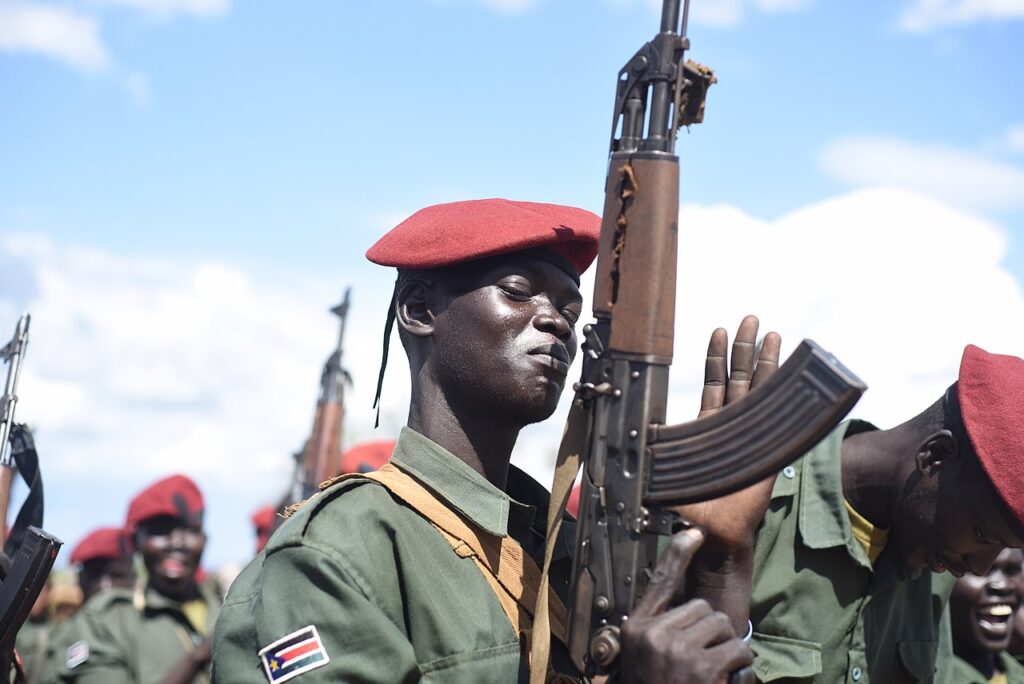
In South Sudan, the world’s newest nation, independence in 2011 was followed almost immediately by civil war. By 2018, approximately four hundred thousand people had died and millions had been displaced — in a country that had spent decades fighting for the right to govern itself. The right, once won, was used to wage ethnic warfare. The Dinka and the Nuer, whose political leaders turned a power struggle into a tribal massacre, are both African. The suffering they created is African-made.
The Lord’s Resistance Army, Joseph Kony’s militia, has operated across Uganda, South Sudan, the Central African Republic, and the Democratic Republic of Congo for decades. It has abducted an estimated sixty to one hundred thousand children, forcing boys to become soldiers and girls to become sexual slaves. Kony claims divine mandate — a specifically Christian apocalyptic theology filtered through Acholi traditional belief. The foreign influence here is not an invading army. It is a religious text, absorbed and weaponised by an African man against African children.
These are the guardians of Africa.
The hierarchies we inherited and kept
Colonial powers did not merely extract resources. They installed hierarchies — racial, ethnic, gender-based, religious — that organised African societies according to European convenience. The Belgians elevated the Tutsi over the Hutu in Rwanda based on pseudoscientific racial theories. The British played Nigerian ethnicities against each other with calculated precision. The French created a Francophone African elite whose primary loyalty was to Paris rather than to their own people.
But here is the question that the guardians of Africa do not like to answer: why, sixty years after independence, are those hierarchies still operational?
Why does ethnic affiliation still determine political loyalty across most of the continent? Why does a Nigerian politician still expect automatic support from his ethnic group, regardless of his record, his competence, or his integrity? Why does a Kenyan voter still ask, “is he one of us” before asking “is he any good?” The colonial powers installed these fault lines. But Africans have maintained them, deepened them, and in many cases found them useful for exactly the same purposes the colonisers did — to divide, to distract, and to dominate.
The gender hierarchy imported through both Christianity and Islam has been absorbed so completely that many African women defend it as tradition. Female genital mutilation, which predates both religions in some regions but has been sustained and in some cases expanded through their influence, is often defended by African women against African women who oppose it, in the name of culture. The foreign idea became the local weapon, and now the local weapon has forgotten its origins.
Homophobia is perhaps the starkest example. Most of the anti-homosexuality laws across Africa are direct inheritances of British colonial law — the same Section 377 that criminalised same-sex relations across the Empire. Independent African nations kept these laws. Some strengthened them. Nigeria’s Same-Sex Marriage Prohibition Act of 2014 was not imposed by a foreign power. It was passed by an elected African legislature, applauded by African religious leaders, and celebrated by ordinary Africans who had been told, by foreign religions, that their gay neighbours deserved persecution. The guardian of Africa signed it into law. And then gay Africans were hunted, trafficked, tortured, and murdered — by other Africans — with the blessing of the state.
This is what the dog collar looks like when you tighten it yourself.
The selective memory of suffering
There is a profound moral inconsistency in how African suffering is remembered and mobilised.
The transatlantic slave trade is rightly mourned and its legacy rightly analysed. But the Arab slave trade — longer, comparably more brutal, and involving the systematic castration and demographic erasure of African men — is largely absent from the public conversation. This is not because the evidence is lacking. It is because the narrative of African victimhood has been curated to serve particular political and religious allegiances. To condemn the Arab slave trade would require confronting Islam’s historical role in African suffering, and that confrontation is too costly in societies where Islam has become inseparable from identity.
Similarly, African-on-African violence is rarely afforded the same moral seriousness as foreign-inflicted violence. When Hilary Ikechukwu Emereole was lured from Owerri to Port Harcourt, assaulted, robbed, and thrown from a hotel window by his attackers, dying months later from his injuries, videos from his funeral showed people celebrating his death. Not mourning. Celebrating. Because he was gay. His killers were African. His mourners were African. His celebrants were African. The foreign influence that enabled his murder was the religious ideology that had taught an entire society that some lives are disposable. But the hands that threw him from that window belonged to Africans. The mouths that celebrated his death belonged to Africans.
The man-made famines of Ethiopia, the starvation strategy of Nigeria’s civil war, the food-as-weapon doctrine deployed by various African governments against their own populations — these rarely generate the sustained moral outrage that, say, Western agricultural subsidies do in African intellectual circles. Foreign economic policy under-develops Africa — this is true and worth resisting. But African governments have also deliberately starved African people. Both things are true. The selective memory that acknowledges only one of them is not resistance. It is self-deception dressed as politics.
By Kenneth Eze


