


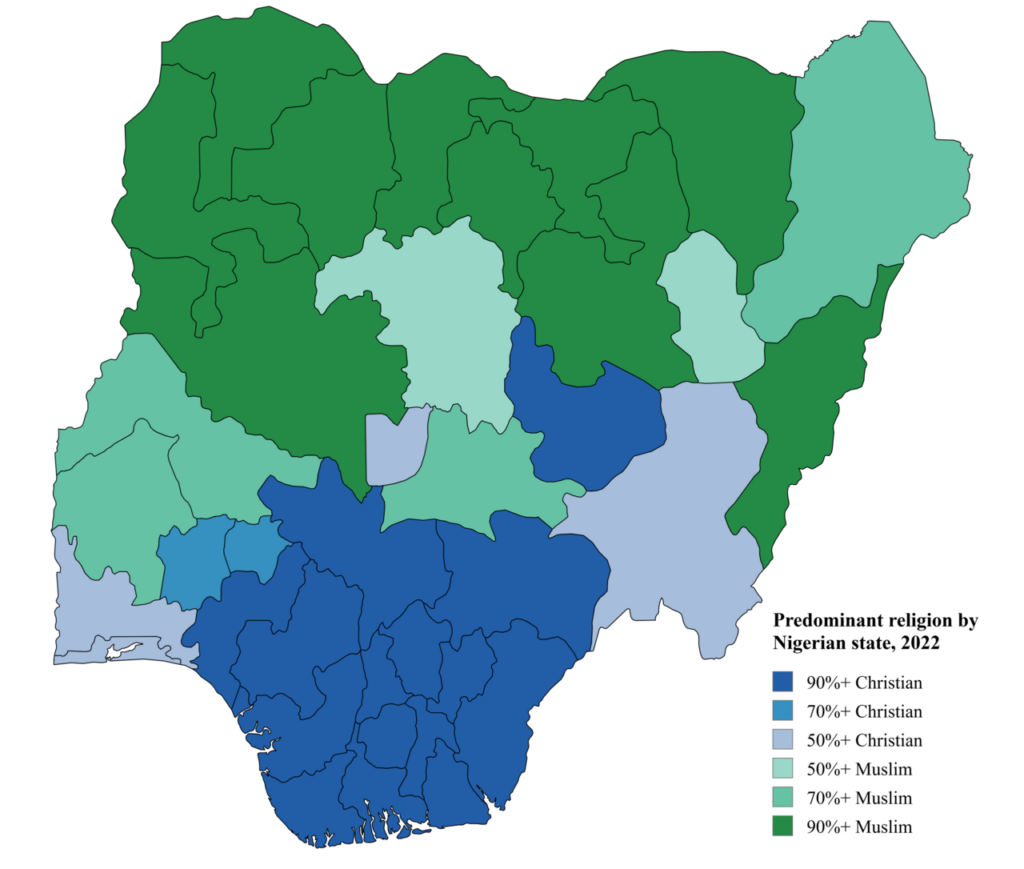
Since the political rollout of Sharia law around the year 2000, Nigeria has been torn apart by the weaponisation of religion. The numbers are staggering. Between 2006 and 2021 alone, the country recorded over 169,000 violent deaths. Of these, over 50,000 were caused directly by insurgent groups like Boko Haram, ISWAP, and Ansaru.
Religious extremism
Let’s be clear: these are not just generic “militants” operating in a vacuum. They are self-declared jihadists operating under an explicit theological banner. They justify their violence using absolute interpretations of Islamic doctrine—using takfir to excommunicate others, fighting to restore a caliphate, and violently rejecting democracy as shirk (idolatry).
Pointing this out isn’t “Islamophobia”. It is simply taking these groups at their own word – reading their communiques and watching their videos. At the same time, the North West and Middle Belt have been bleeding from a relentless mix of armed banditry and ethnic clashes, overlapping in the exact same spaces. This sustained loss of life isn’t just a tragic statistic. It is the direct, physical consequence of absolute belief systems turning into real-world violence.
The roots of this bloodshed lie in a dangerous mix of identity politics, rigid doctrine, and manipulated anger. The ideological DNA of groups like Boko Haram and Ansaru didn’t appear out of nowhere. It was incubated in unregulated madrasas and fuelled by extreme clerical rhetoric, while moderate voices failed to contain the fire. Pretending that this religious ideology is just a side effect of poverty or poor governance is a dangerous denial that has only prolonged Nigeria’s suffering.
Look at the November 2002 “Miss World Riots” in Kaduna. A single newspaper article triggered a sectarian slaughter that left around 250 people dead, with victims targeted purely for their religion or ethnicity. Similarly, the once-peaceful city of Jos has become a recurring war zone. Successive riots between 2001 and 2010 claimed anywhere from 4,000 to 7,000 lives, hardening the divides between communities and passing down deep trauma to the next generation. Nigeria has paid an obscene price in blood for failing to confront the religious ideas driving this terror.
However, an honest look at Nigeria’s religious landscape requires admitting that radical Islamism doesn’t have a monopoly on dangerous fanaticism. Christian fundamentalism has the exact same capacity for violent zealotry and exclusion. Yet, Christian extremism in Nigeria hasn’t exploded in the same way. This restraint doesn’t come from some inherent Christian pacifism. It comes from the calculating self-interest of its leaders.
The pioneers of Nigeria’s prosperity gospel operate fundamentally as businessmen. They know that a holy war is terrible for profit. Their main goal is to exploit the poor and accumulate earthly luxuries: private jets, massive estates, and tax-free mega-churches. Sparking a violent fundamentalist uprising would destroy the very economic structures they use to extract wealth from their desperate followers. Simply put, a displaced or dead congregation cannot pay tithes.
This contrast – between violent jihadist absolutism and calculating mega-church capitalism -forces a critical question. If the ultimate result of absolute belief is structural and physical violence, we must ask where these dogmas naturally lead. When belief stops being a personal spiritual journey and becomes an absolute, political mandate, does it inevitably require the destruction of the “other”?
It is at this grim intersection of faith, power, and exploitation that we must dismantle the true cost of acting “In the Name of Allah” – or any deity invoked to justify human suffering.
“Ideas are bulletproof “ – V for Vendetta
To chart a viable way forward, we must first be intellectually honest about the role of kinetic force.
The Nigerian military and regional task forces have achieved undeniable, hard-won victories. Through immense sacrifice, they have reclaimed seized territories, degraded the operational command of Boko Haram and ISWAP, and prevented the complete collapse of state authority in the Northeast. They applied the necessary tourniquet to stop the immediate bleeding. We cannot have a serious conversation about peacebuilding without acknowledging the men and women who held the physical line against total anarchy.
However, a tourniquet is not a cure. The fundamental limitation of a strictly military response is that you cannot bomb an ideology into extinction. Bullets can neutralize a combatant, but they cannot kill the absolutist dogma that radicalized him in the first place.
This is where we must pivot from kinetic warfare to the gruelling work of civil conflict transformation. As peace and conflict scholar Ulrich Schneckener argues, the post-9/11 “war on terror” paradigm – which relies overwhelmingly on military intervention and the top down imposition of state order – is a deeply flawed model for lasting security. Schneckener emphasizes that sustainable peace cannot be magically air-dropped by international interventions, nor can it be enforced permanently through the barrel of a gun. True peace must be fought for, negotiated, and won by society itself. I add that sustainable peace must also be maintained, through the sacrifices and diligence of that society.
Dismantling the ideology
Applying this framework to Nigeria means we must build a non-kinetic infrastructure that is just as aggressive and well-resourced as our military campaigns. We have degraded the terrorist hardware. Now we must dismantle their ideological software. This requires a multi-layered approach to conflict transformation grounded in local ownership, through five critical pillars of civil transformation:
Dismantling the Manpower Pipeline (Generational Poverty and the Almajiri System)
Extremist groups do not build armies out of thin air. They harvest them from oceans of generational poverty. The Almajiri system in Northern Nigeria has long served as a captive breeding ground for this foot-soldiery – millions of undocumented, uneducated, and desperate children left entirely vulnerable to radicalization.
However, we cannot dismantle this pipeline without addressing the uncomfortable mathematical reality of explosive population growth. Any economic intervention must be coupled with the aggressive development and promotion of a culturally accepted system of birth control. Without managing our demographics, we are simply out-breeding our capacity to educate and employ, serving up an endless supply of manpower to warlords.
Sealing the Recruitment Portal (Reclaiming the Ideological Space)
We can no longer afford to leave the pulpit and the mosque unregulated. Religious institutions serve as the primary recruitment portals for extremism, and the state must actively reclaim this civic space. This requires the mandatory registration and strict monitoring of all religious bodies, accompanied by an absolute, zero-tolerance policy for anti-government rhetoric, hate speech, and the weaponization of dogma. Freedom of religion cannot be a blank check for inciting treason or sectarian violence. The state must make the ideological marketplace actively hostile to absolutism.
Healing New Traumas (Psychological and Social Rehabilitation)
You cannot rebuild a functioning society with a profoundly traumatized populace. Decades of violence have normalized brutality and created entirely new sources of trauma that risk sparking future cycles of revenge. Authentic rehabilitation requires active, community-level psychological intervention that explicitly encourages citizens to unlearn deep-seated prejudices and adopt the principles of a modern, pluralistic society—where civic duty and human rights supersede religious mandates. Furthermore, this must become a pillar of our educational system. We must teach the dark, unvarnished history of our religious crises in schools. If we do not actively remind ourselves of the bloodshed our dogmas have caused, we are doomed to repeat it.
Grassroots Civil Transformation (The People Must Maintain the System)
Top-down government edicts will fail without the buy-in of the people who actually live in these conflict zones. We need to empower local mediators, grassroots organizers, and even reformed combatants who have abandoned the radical path. They possess the localized credibility required to bridge the gap between hostile factions. Peacebuilding in this context isn’t about ignoring differences. It is about forging a shared civic identity—a resilient social contract—that values human life and collective progress far above rigid theological divides.
Enforcing Secularism (Government and Police Reformation)
Finally, none of these solutions can take root in a state apparatus that is fundamentally compromised. Having spent nearly a decade within the Nigerian civil service, I have witnessed firsthand a system that is incredibly inefficient, highly corrupt, and – most fatally – deeply and performatively religious.
The machinery of government has been paralyzed by misplaced piety. It is an open secret that the average “policy meeting” consists of an opening Christian prayer, eating food, gisting, filling out the attendance sheet to claim allowances, and a closing Islamic prayer – with zero actual governance achieved in between. This is not merely a waste of time – it is the institutionalisation of neglect. This mockery of statecraft must end and the government must be a sanctuary of absolute neutrality with secularism ruthlessly enforced. This means that the mosques and churches currently occupying space within government institutions and complexes must be demolished. The state cannot afford to be a patron of competing deities when its primary, urgent responsibility is the survival and progress of ALL its citizens.
The Deaf Heavens: Why We Must Save Ourselves
The tragedy of the Niger Area is fundamentally rooted in its historical subjugation. Ever since the unprovoked jihad of Uthman ibn Fodi swept through Northern Nigeria in the name of Allah, and colonial imperialists systematically dismantled African heritage to impose Christianity in the name of Yehoshua, the region has been irrevocably fractured. We have inherited a deeply schizophrenic identity: we fiercely guard the religions of our conquerors while diligently maintaining the brutality of our slave masters.
Today, this inherited zealotry permeates every stratum of the Nigerian state. Nigeria is consistently cited as one of the most religious countries on Earth, defined by extreme levels of daily prayer, obsessive religious service attendance, and performative public piety. Yet, this devotion comes at the absolute expense of our republic. Civic duty, constitutional order, and basic human decency are routinely abandoned in favour of appeasing imported gods from the Middle East.
This bias is woven into the very fabric of our state. Our national anthem opens with an appeal to “O God of Creation,” immediately sidelining secularism and dismissing the scientific reality of human evolution. Furthermore, the architecture of our political instability – from the earliest military coups to the machinations of successive civilian governments – has been consistently driven, or deeply colored, by religious motives and sectarian biases. The state is incapable of neutrality. It takes sides, compromised by the overwhelming religiosity of its populace.
The socioeconomic paradox this creates is staggering. We boast the poorest, most desperate congregations on the continent, yet we produce the wealthiest pastors. On the other side of the divide, as the most violent iterations of Islam have taken root, the government continues to coddle Emirs and Imams who have utterly failed to challenge this extremism.
The hypocrisy of this religious establishment is glaring and deadly. To date, there has been no unified, definitive fatwa issued against Boko Haram or ISWAP – organizations that, according to moderate clerics, have entirely bastardized the Quran. Yet, in 2002, it took less than twenty-four hours for multiple death-sentence fatwas to be decreed against Isioma Daniel, a non-Muslim journalist, simply for writing an article about the Miss World pageant. This glaring double standard destroys the comforting lie that Sharia law is exclusively a Muslim affair. It is, in practice, a tool of absolute, overarching dominance.
For sixty-five years as an independent nation, we have prayed, cried, and yelled at God and Allah for salvation. It would be generous to say that nothing has changed. The agonizing truth is that things have become exponentially worse. We have cast millions of prayers a day – trillions of supplications over six decades – into the void, and our reward is the grim reality of our present. Relative to our massive population, we are arguably the poorest, most undeveloped nation on earth, paralyzed by unprecedented corruption and greed. The empirical evidence is undeniable: not a single prayer has ever been answered.
Allah will not save us.
God will not rescue us.
The time for prayer is dead.
The culmination of the Nigerian experiment necessitates a chillingly clinical realization. The metaphysical realm is not merely distant, but fundamentally indifferent to the structural decay of the post-colonial state. After six decades of performative piety – a period in which trillions of supplications were cast into a persistent ontological void – the empirical reality of our national atrophy renders the hypothesis of divine intervention not only improbable but demonstrably fallacious.
Our descent into unprecedented immiseration, despite being the most prayer-saturated demographic on the planet, confirms that the epoch of liturgical escapism is dead. Heaven does not descend to reconstruct the societal ruins that we, through systemic corruption and theological paralysis, refuse to remediate. There is no celestial cavalry, no metaphysical rescue descending upon a beam of light to rectify our self-inflicted sociopolitical entropy.
We must, therefore, exhume ourselves from the anaesthetic lullabies of submission and incinerate the comforting lies that have kept the collective populace in a state of genuflecting palsy while our sovereign birthright was plundered. The silence of the heavens is not an absence, but a visceral, thundering mandate for human agency. We are the very miracle for which we have been mendicants.
Ultimately, the survival of the Nigerian state demands that we abandon the hollow comfort of waiting and embrace the gruelling burden of becoming. We must forge a nation anchored not upon the ephemeral foundations of prayer mats and altars, but upon the tempered steel of our own collective will, the unvarnished sweat of our own labour, and the uncompromising truth that no deity will redeem a people too intellectually ossified and spiritually enfeebled to save themselves.
By ESS Donli